Recently, I read two articles from wildly different websites. One is a pretty old article from a few years back in the New York Times about people who are obsessed about their net worth. The other is an article about the dynamics of power in social interaction in an internet humor website. Both are pretty good reads. And both of them touch on the same theme: our society has trained us not to talk about power dynamics between friends and coworkers.
I have two social circles. One circle is full of friends who are vastly less successful (as measured by traditional socioeconomic measures) than I am. And the other, all of my friends are upper middle class (college educated + career-track job). I don't mix them. The primary reason is because I don't want my friends in the latter group to think less of me for having unsuccessful friends. It sounds pretty shitty, but there you go.
When I hang out with my less successful friends, there is always a certain tension that hangs in the air. I never bring up my job. And I catch myself censoring what I'd like to talk about when the conversation moves towards money. When my friends ask me (probing delicately around what they really want to ask) about my financial situation, I answer truthfully without any accompanying context. They never flat out ask me the things they really want to know (how much money I make or how much I'm worth).
I hate it. It drives me crazy. I don't know anything else that is unspoken yet carries such a palpable feeling of dread and taboo. Collectively, we have all bought into the idea that America is free of class. So you're always going to rock the boat when you talk about the things that divide America in its shadow class system. So that means you can't talk about money and education (half of which is really a way to signal status) except when you're just dancing on the edges.
Which is frustrating. Because these issues shouldn't be confined to somber discussions at the dinner table (after the kids have gone to bed) and at the desk of your financial adviser (if you're rich/aware enough to have one) or reading about finance articles when you're alone. Because society has tied "success" completely to your job and your income (it's not enough to be a rich plumber), it's almost impossible to talk about what really matters: the importance of financial security.
What's worse, we're hardwired not to care about it until we need it the most. You're never as plugged into your finances until you've been laid off. And by the time that happens, for most people it's too late. This is something that even the upper middle class is mostly unaware about. Retirement is so far off into the future and we make plenty of money to satisfy our current needs and wants. Why bother doing a real audit of our situation?
I don't mean for this post to come off as a ridiculously self satisfied humblebrag. This issue means a lot to me. My parents never addressed money and financial security when I was a kid. But I remember the screaming matches late at night. That's something I wouldn't wish on anybody. And it's why I'm constantly evangelizing the importance of saving and investing.
Monday, March 18, 2013

Monday, March 11, 2013
The Times, They Are a Changin'
I'm not completely done with my SimCity binge, but I'm nearing some sort of phase where I can envision spending less than 95% of my spare time playing it. And when that time comes, I do plan on overhauling this blog and adding features. Stay tuned.
Thursday, March 7, 2013
SimCopter One Reporting Heavy Distraction
Hey, guys. SimCity just got released and essentially all of my free time is going towards playing this absurdly addictive game. I'll try and make updates during this time, but I simply can't guarantee anything.
Tuesday, March 5, 2013
An Example of the Culture of Dependency
Over at The Atlantic, Derek Thompson (whom I've had a bone to pick with before) is again spouting nonsense about things he doesn't really know anything about. This time, it's about corporate profits. In a blog post provocatively titled "Corporate Profits Are Eating the Economy", he talks about how the profits of Corporate America have increased at a much faster clip than US GDP or wages.
His conclusion is extremely wrongheaded and highly revealing. His last paragraph reads:
This is the problem with perception that many "skill" workers have with the companies that employ them. They think that because the company they work at treats them well and gives them a good wage, that companies everywhere should do the same for every worker. But the reality is that companies only treat their employees as good as they need to. And when an opportunity exists for cutting costs, shedding dead weight, or shuttering entire divisions, you can bet that management will take it.
The reason why companies like Google pays its employees so well is because the employees they hire are extraordinarily talented. Their software developers are treated like rock stars because there aren't many talented developers in the labor market and Google is a company whose profits and reputation rest upon the utility of their software. Media companies like the Atlantic Media Company pay its writers well because they want good, reliable writers that are hard working and relatively sophisticated wordsmiths. Those too, surprisingly, are in short supply.
When times are good and profits are high, companies expand their payrolls and efficiency gets relaxed upon the altar of inertia: "who cares? Our stock is still soaring". But when times are hard, the McKinsey and Bain consultants come in, tell the corporate leadership that 20% of their employees are unnecessary, dead weight, or even counterproductive, and then payrolls get slashed until the company gets lean.
If you're fired or laid off, and if you don't have any (currently) relevant skills, the next job you get will pay substantially less than your former position. And when that happens, and people realize their emergency fund barely covers 1 month worth of expenses and start dipping into whatever meager savings they have (or start raiding their 401ks in a disastrously short sighted way to keep afloat), reality hits them hard. They had things going so well for so long that they assumed it would continue in perpetuity (or at least until they made the decision to voluntarily retire).
That kind of dependency is horrifying. Because you aren't depending on your friends or family. You're depending your very livelihood on an entity that, at the end of the day, only has eyes on the bottom line. That is sheer lunacy.
What so many people forget is that nobody deserves a well paying job. Your compensation is tied directly to how valuable you are to somebody else. And when disruptive technologies or market conditions suddenly make your labor less valuable to somebody else, you get laid off. So what were you doing during the good times? Saving money?
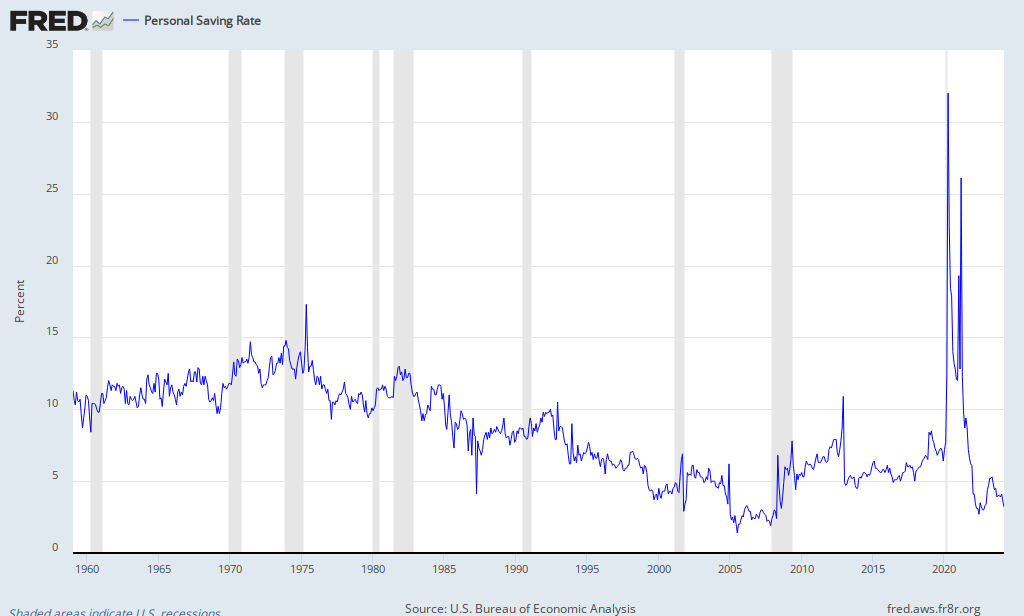
Hah! Yeah right. Like most Americans, you were taking out home equity loans to pay for kitchen and bath renovations or paying for new cars even when your 6 year old car was still perfectly serviceable for an additional 5+ years.
See
that? The personal savings rate hasn't been above 10% for 30 years. And
you're kidding yourself if you think saving 5% per year is enough to
get by when unpredictable events wreck your car, make you sick, or takes
away your job.

His conclusion is extremely wrongheaded and highly revealing. His last paragraph reads:
A growing economy and lower unemployment should eventually give U.S. workers a long-deserved raise (and so should rising labor costs overseas that persuade more companies to hire domestically). But improvements in technology and the ability of companies to hire locally as they chase worldwide demand are just two factors that should restrain any optimism we can keep corporate profits from gobbling up more and more of the economy. Workers still need help -- and they certainly won't find it in the sequester.When the Republicans rail against "the culture of dependency", this can serve as one of the most prominent examples. And the author doesn't even realize that he himself is living in dependency. He writes about the extraordinary growth of corporate profits and bemoans the lack of wage growth during the same period. Does he offer any solution? No. He hopes, vainly, that companies flush with profits will pass it along to their workers.
This is the problem with perception that many "skill" workers have with the companies that employ them. They think that because the company they work at treats them well and gives them a good wage, that companies everywhere should do the same for every worker. But the reality is that companies only treat their employees as good as they need to. And when an opportunity exists for cutting costs, shedding dead weight, or shuttering entire divisions, you can bet that management will take it.
The reason why companies like Google pays its employees so well is because the employees they hire are extraordinarily talented. Their software developers are treated like rock stars because there aren't many talented developers in the labor market and Google is a company whose profits and reputation rest upon the utility of their software. Media companies like the Atlantic Media Company pay its writers well because they want good, reliable writers that are hard working and relatively sophisticated wordsmiths. Those too, surprisingly, are in short supply.
When times are good and profits are high, companies expand their payrolls and efficiency gets relaxed upon the altar of inertia: "who cares? Our stock is still soaring". But when times are hard, the McKinsey and Bain consultants come in, tell the corporate leadership that 20% of their employees are unnecessary, dead weight, or even counterproductive, and then payrolls get slashed until the company gets lean.
If you're fired or laid off, and if you don't have any (currently) relevant skills, the next job you get will pay substantially less than your former position. And when that happens, and people realize their emergency fund barely covers 1 month worth of expenses and start dipping into whatever meager savings they have (or start raiding their 401ks in a disastrously short sighted way to keep afloat), reality hits them hard. They had things going so well for so long that they assumed it would continue in perpetuity (or at least until they made the decision to voluntarily retire).
Our country has a spending problem. People spent too much money when times are good and never saved any of it. And once things turned bad and stayed bad, everybody realized that their situation was far more precarious than they ever thought. Collectively, we are far too dependent on our jobs. It remains most people's only source of income. It defines people at a personal level (I am a software developer, not a person who just happens to develop software). And the fact is it can be taken away by a company so very easily.
That kind of dependency is horrifying. Because you aren't depending on your friends or family. You're depending your very livelihood on an entity that, at the end of the day, only has eyes on the bottom line. That is sheer lunacy.
What so many people forget is that nobody deserves a well paying job. Your compensation is tied directly to how valuable you are to somebody else. And when disruptive technologies or market conditions suddenly make your labor less valuable to somebody else, you get laid off. So what were you doing during the good times? Saving money?
Hah! Yeah right. Like most Americans, you were taking out home equity loans to pay for kitchen and bath renovations or paying for new cars even when your 6 year old car was still perfectly serviceable for an additional 5+ years.
 |
| Our country's relative decline, summarized in one handy-dandy chart. |
That is my actual net worth (courtesy of Mint.com)
at the time of this blog post. I'm 26 days from turning 25 years old. I
save and invest about 15% of my after-tax pay in my taxable brokerage
account. My 401k account gets a pre-tax 13% contribution (including the
company match). Another 8% after-tax goes into my Roth IRA. And every
month, I reduce the principal on my mortgage by 500 dollars. Almost half
of my take home pay is dedicated towards increasing my net
worth. And even then, I know that if I were to lose my job tomorrow, I
would still be in a terrible financial position.
I need about 10 more years of doing what I'm currently doing (employed at a career-track job, saving as I currently am) before I can realistically have the slightest modicum of financial independence. Because even though I am so much better off than the vast majority of 25 years old, it's still nowhere close to safety, or even relative comfort. My situation is only slightly less precarious than the average 25 year old American.
But if I continue to be lucky, and to be honest with myself, I can gain relative financial independence in about 15 years. Otherwise, I'll be just like any other American out there. One firing, downsizing, or injury away from a personal financial death spiral.
That is the kind of dependency that the vast majority of Americans find themselves in without even realizing it. If you asked a 25 year old what their idea of independence is, it's a job that allows them to pay for a cell phone and wireless plan, an apartment lease, a used car, food and groceries, and beer. A 35 year old's idea of independence isn't too far removed from that either.
So let's go back to Derek Thompson's blog post. He complains that corporate profits are too far removed from GDP and wage growth. My advice? Buy corporate equity and get some of those record profits for yourself. The barriers to retail investing have never been lower than they are now. Are you complaining about corporate profits? Guess what? You can buy a share of it. Open an account at Fidelity and deposit just 2.5k into a Roth IRA. You can buy 16 shares of an S&P 500 index fund (I recommend either IVV or SPY) commission free. You can use your tax return refund for it instead of buying that new flat screen TV and couch you had your eye on.
The majority of Americans are fortunate enough to be able to work their way into financial independence. There is only the culture of dependence holding them back.
Monday, March 4, 2013
Chalk Up Another "W" For Predictions
Today, I stand vindicated on Joe Flacco's contract negotiations. Just today, the NFL reported that Flacco's guaranteed amount over this 6 year deal is 52 million, barely within the 15% range I allotted for a 6 year deal.
Honestly, I thought Flacco's agent would have been able to get a better deal out of the Ravens. And while the headline number (120 million) seems impressive, the only thing that matters is the guaranteed amount because player contracts can get shredded or renegotiated to avoid balloon payments if the player doesn't pan out.
This puts me at 2 right, 1 wrong with a few predictions still outstanding. The Supreme Court is due to rule on Fisher v Texas sometime this year, so I'm going to expect at least 1 more vindication this year.
Predictions Outstanding: 3 (Marissa Meyer, Fisher v Texas, Michael Dell)
Predictions Vindicated: 2 (2012 Presidential election, this)
Predictions Erroneous: 1 (Romney Veepstakes)
Honestly, I thought Flacco's agent would have been able to get a better deal out of the Ravens. And while the headline number (120 million) seems impressive, the only thing that matters is the guaranteed amount because player contracts can get shredded or renegotiated to avoid balloon payments if the player doesn't pan out.
This puts me at 2 right, 1 wrong with a few predictions still outstanding. The Supreme Court is due to rule on Fisher v Texas sometime this year, so I'm going to expect at least 1 more vindication this year.
Predictions Outstanding: 3 (Marissa Meyer, Fisher v Texas, Michael Dell)
Predictions Vindicated: 2 (2012 Presidential election, this)
Predictions Erroneous: 1 (Romney Veepstakes)
Saturday, March 2, 2013
Real Time With Bill Maher: Counterpoints (3/1/13)
Good show, although the mid-show interview guest really sucked up valuable time from a moderately strong panel. Let's get to the topics covered and set the record straight:
1. Gavin Newsom says sequestration cuts may only amount to 2.5% of the Federal budget, but it is devastating to discretionary spending:
Unfortunately Newsom got the figure wrong. The sequestration cuts scheduled for the current fiscal year total 46 billion dollars, which represents only 1.3% of fiscal 2013. It's split mostly down the middle between non-defense discretionary spending and defense spending, slightly favoring the military. About 25 billion gets taken out of the Pentagon, which represents about a 3% trim across the board. The rest hits the Federal cabinets and agencies that most people view as actual "government" (rather than just programs that shuffle transfer payments from one constituency to another) and represents about a 5% cut across the board.
Only in government is a 1.3% spending cut viewed as a political disaster. In the private sector, managers will ruthlessly cut their departments and payroll down to the bone. And for the most part, they get away with it because it turns out that there are a lot of employees who are nothing but dead weight. As a personal anecdote, our department was tasked with finding around 5% in savings in the overall operational budget. We got rid of things like bagel Thursdays and froze hiring. There was some grumbling, but President Obama and the Democrats are trying to exaggerate the effects of sequestration.
I get that government bureaucracies are much less nimble than their private sector counterparts, but the government could easily shed a lot of its workforce and its redundant programs and the country would be no worse off for it. On the contrary, I think getting rid of unneeded government is a net plus because those dollars and workers then go back into the private sector. The opportunity cost of government is at an all time high right now. Policy wonks need to stop looking at the budget numbers and start looking at the regulations that make it impossible for top level bureaucrats to fire nonproductive employees or shuttering redundant and useless programs.
2. Bill Maher says Republicans can't chide Obama for deficit spending when Bush and Reagan ran up the national debt:
It's true that the national debt expanded greatly under Reagan. During the Reagan Administration, the national debt tripled from around .9 billion to about 2.7 trillion. What gets lost in translation is that a 300% increase in the national debt is misleading because what really matters is the debt to GDP ratio. During the same time, the country's GDP increased from 3.1 trillion to 5.5 trillion. When you look at the increase in relative debt, from 29% to 49%, it's only a 69% increase over the course of the Reagan Administration.
Granted, 69% still seems like a huge number. But it's a much better number than 300%. And it also needs to be viewed in context. Going to about 50% debt to GDP ratio isn't too bad. It's a healthy number when you look at Italy (120%), France (86%), Japan (an astounding 220%!), Germany (82%), the United Kingdom (86%), and the US' current ratio (105%).
In short, when the times change, the numbers take on different meaning. It's okay for a country to deficit spend when its overall debt levels are low. But it becomes increasingly dangerous when debt levels are already high. When you're playing football, down and distance drastically alter the options in your playbook. No coach would call a run on 4th and 15. But that's what we're doing now.
3. Bill Maher wants to cut the defense budget:
It seems like every other show, Maher is constantly ranting about the huge defense budget the US has. And while I agree that there is an extraordinary amount of waste in the budget, our military readiness will erode if we don't match cuts with reforms in the procurement and investment operations of our armed forces. During peacetime, we have 435 commanders in chief of the budget, and everybody wants military spending in their district. That stretches the procurement process in terms of both time and money. There are bogus regulations that make it impossible for the military's logisticians to efficiently utilize the resources given to them.
I would be fine with cuts in the defense budget if we could cut Congress out of the spending process. Otherwise, I don't like the fact that our military is shouldering a higher percentage of the sequestration cuts than the rest of the government. We could have halved the Social Security cost of living adjustment for 1 year and paid for the defense sequestration cuts.
4. Everybody wants to legalize marijuana:
I thought it was extremely arrogant and self-serving of Gavin Newsom for chiding politicians for not telling the public their private views on the Controlled Substances Act. It's so much easier for the former Mayor of San Francisco and the current Lieutenant Governor of California to come out publicly in favor of marijuana legalization than it is for a Senator like Lindsey Graham to come out for comprehensive immigration reform in a state like South Carolina.
I think the odds are about 50/50 for marijuana to get decriminalized at the Federal level within 5 years. And I hope it gets legalized at the state level. This is a political winner and as more and more old people die off, it'll become politically feasible to put an end to the War on Drugs.
5. Steve Schmidt hates the Republicans who identify with CPAC:
His rant about the out-of-touch angry conservatives at CPAC just nailed it. I have so much frustration over this element of the GOP, which has made it impossible for libertarians like me to call the GOP home. The fact is there are a ton of good things in the GOP platform. Chris Christie is popular within his home state because he takes the GOP's economic planks and leaves the social ones. It's time we shunted the prejudiced social conservatives to the side of the party or completely out of it.
5. Toyota Technicals are reliable:
Absolutely brilliant. It speaks to the prowess and incredible reliability of Japanese engineering. Although it also helps African warlords. But hey, you can't blame Toyota for putting out a quality product.
6. Snoop Dog (I refuse to call him Snoop Lion) got old.
1. Gavin Newsom says sequestration cuts may only amount to 2.5% of the Federal budget, but it is devastating to discretionary spending:
Unfortunately Newsom got the figure wrong. The sequestration cuts scheduled for the current fiscal year total 46 billion dollars, which represents only 1.3% of fiscal 2013. It's split mostly down the middle between non-defense discretionary spending and defense spending, slightly favoring the military. About 25 billion gets taken out of the Pentagon, which represents about a 3% trim across the board. The rest hits the Federal cabinets and agencies that most people view as actual "government" (rather than just programs that shuffle transfer payments from one constituency to another) and represents about a 5% cut across the board.
Only in government is a 1.3% spending cut viewed as a political disaster. In the private sector, managers will ruthlessly cut their departments and payroll down to the bone. And for the most part, they get away with it because it turns out that there are a lot of employees who are nothing but dead weight. As a personal anecdote, our department was tasked with finding around 5% in savings in the overall operational budget. We got rid of things like bagel Thursdays and froze hiring. There was some grumbling, but President Obama and the Democrats are trying to exaggerate the effects of sequestration.
I get that government bureaucracies are much less nimble than their private sector counterparts, but the government could easily shed a lot of its workforce and its redundant programs and the country would be no worse off for it. On the contrary, I think getting rid of unneeded government is a net plus because those dollars and workers then go back into the private sector. The opportunity cost of government is at an all time high right now. Policy wonks need to stop looking at the budget numbers and start looking at the regulations that make it impossible for top level bureaucrats to fire nonproductive employees or shuttering redundant and useless programs.
2. Bill Maher says Republicans can't chide Obama for deficit spending when Bush and Reagan ran up the national debt:
It's true that the national debt expanded greatly under Reagan. During the Reagan Administration, the national debt tripled from around .9 billion to about 2.7 trillion. What gets lost in translation is that a 300% increase in the national debt is misleading because what really matters is the debt to GDP ratio. During the same time, the country's GDP increased from 3.1 trillion to 5.5 trillion. When you look at the increase in relative debt, from 29% to 49%, it's only a 69% increase over the course of the Reagan Administration.
Granted, 69% still seems like a huge number. But it's a much better number than 300%. And it also needs to be viewed in context. Going to about 50% debt to GDP ratio isn't too bad. It's a healthy number when you look at Italy (120%), France (86%), Japan (an astounding 220%!), Germany (82%), the United Kingdom (86%), and the US' current ratio (105%).
In short, when the times change, the numbers take on different meaning. It's okay for a country to deficit spend when its overall debt levels are low. But it becomes increasingly dangerous when debt levels are already high. When you're playing football, down and distance drastically alter the options in your playbook. No coach would call a run on 4th and 15. But that's what we're doing now.
3. Bill Maher wants to cut the defense budget:
It seems like every other show, Maher is constantly ranting about the huge defense budget the US has. And while I agree that there is an extraordinary amount of waste in the budget, our military readiness will erode if we don't match cuts with reforms in the procurement and investment operations of our armed forces. During peacetime, we have 435 commanders in chief of the budget, and everybody wants military spending in their district. That stretches the procurement process in terms of both time and money. There are bogus regulations that make it impossible for the military's logisticians to efficiently utilize the resources given to them.
I would be fine with cuts in the defense budget if we could cut Congress out of the spending process. Otherwise, I don't like the fact that our military is shouldering a higher percentage of the sequestration cuts than the rest of the government. We could have halved the Social Security cost of living adjustment for 1 year and paid for the defense sequestration cuts.
4. Everybody wants to legalize marijuana:
I thought it was extremely arrogant and self-serving of Gavin Newsom for chiding politicians for not telling the public their private views on the Controlled Substances Act. It's so much easier for the former Mayor of San Francisco and the current Lieutenant Governor of California to come out publicly in favor of marijuana legalization than it is for a Senator like Lindsey Graham to come out for comprehensive immigration reform in a state like South Carolina.
I think the odds are about 50/50 for marijuana to get decriminalized at the Federal level within 5 years. And I hope it gets legalized at the state level. This is a political winner and as more and more old people die off, it'll become politically feasible to put an end to the War on Drugs.
5. Steve Schmidt hates the Republicans who identify with CPAC:
His rant about the out-of-touch angry conservatives at CPAC just nailed it. I have so much frustration over this element of the GOP, which has made it impossible for libertarians like me to call the GOP home. The fact is there are a ton of good things in the GOP platform. Chris Christie is popular within his home state because he takes the GOP's economic planks and leaves the social ones. It's time we shunted the prejudiced social conservatives to the side of the party or completely out of it.
5. Toyota Technicals are reliable:
Absolutely brilliant. It speaks to the prowess and incredible reliability of Japanese engineering. Although it also helps African warlords. But hey, you can't blame Toyota for putting out a quality product.
6. Snoop Dog (I refuse to call him Snoop Lion) got old.
Friday, March 1, 2013
The Breathtaking Arrogance of the Blogosphere*
Eight months after female journalists collectively gushed over Yahoo!'s announcement that Marissa Mayer would be taking the firm's top job, the long knives have come out over her controversial decision to require all telecommuting workers to start working in the office again. Feminists have soured on her. Clueless bloggers said her decision is wrong and back up their claims with anecdotes, meaningless PC drivel, statistical studies (that are not statistically relevant to Yahoo!). If you only read read the non-financial news over the past week, you'd be given the impression that Marissa Mayer was a terrible CEO and a bad person in general.
Luckily there was at least one person who had a modicum of reason. And it simply boils down to this: she's the boss and what she says goes. If you don't like it, work somewhere else. It takes an extraordinary amount of arrogance to say a CEO is wrong on a policy she crafted for her own company by citing the policies of other companies, who may or may not be in the same boat that Yahoo! is in.
I've already gone on the record stating that I don't think Mayer is going to turn around the ship. And it's not because I think she's not a good chief executive. It's because I think that Yahoo! just isn't in any good position to become a dominant tech company. They've been coasting on inertia for years, and their momentum slows down with each passing year. Their one claim to fame has been an okay search engine (since supplanted by Google) and a deal (since terminated) with Microsoft to make Yahoo! the default home page of Internet Explorer.
Mayer is trying to turn around the ship. And she's trying to do it by changing the corporate culture, trimming the copious amounts of excess fat, and by focusing Yahoo! as an online media site. The latter two are simply plans for a managed decline and the former is almost impossible. Culture can't be imposed from the top down, at least, not easily. It took Peter the Great decades changing Tsarist Russia into a modern European empire and while he was able to change the culture of his Royal Court (he was, after all, an autocrat), the serfs were still serfs.
Mayer is an autocrat in the sense that she can essentially rule by diktat. The board has given her quite a bit of leeway and shareholders have actually received her pretty well, as evidenced by Yahoo!'s stock price:
This is the fundamental problem with the blogosphere. Everybody has an opinion. And if you happen to work for Slate, The Atlantic, CNN, MSNBC, or any other major media/news organization, you get paid quite a bit to share your opinion with the masses. But sometimes the bloggers are writing on matters that they have absolutely no expertise in. These people are nothing more than excellent students who graduated from top universities and then did a grueling, low-paid (or unpaid) internship in order to have a shot at becoming a salaried writer.
I'm essentially invoking the Vietnam argument. You don't know, man. Because you weren't there! Having a B.A in liberal arts from Harvard gives you no credentials to second guess a CEO. Knowing how to use an iPhone doesn't qualify you to wax poetic on Apple's stock price. Being a decent wordsmith doesn't make you a decent analyst. But all of those headlines and those opinions and those insufferably arrogant bloggers try and pretend otherwise.
Frankly, I'm sick of it. These are the opinion shapers of America, and they're doing the rest of the country a huge disservice.
* I realize and appreciate the irony.
Luckily there was at least one person who had a modicum of reason. And it simply boils down to this: she's the boss and what she says goes. If you don't like it, work somewhere else. It takes an extraordinary amount of arrogance to say a CEO is wrong on a policy she crafted for her own company by citing the policies of other companies, who may or may not be in the same boat that Yahoo! is in.
I've already gone on the record stating that I don't think Mayer is going to turn around the ship. And it's not because I think she's not a good chief executive. It's because I think that Yahoo! just isn't in any good position to become a dominant tech company. They've been coasting on inertia for years, and their momentum slows down with each passing year. Their one claim to fame has been an okay search engine (since supplanted by Google) and a deal (since terminated) with Microsoft to make Yahoo! the default home page of Internet Explorer.
Mayer is trying to turn around the ship. And she's trying to do it by changing the corporate culture, trimming the copious amounts of excess fat, and by focusing Yahoo! as an online media site. The latter two are simply plans for a managed decline and the former is almost impossible. Culture can't be imposed from the top down, at least, not easily. It took Peter the Great decades changing Tsarist Russia into a modern European empire and while he was able to change the culture of his Royal Court (he was, after all, an autocrat), the serfs were still serfs.
Mayer is an autocrat in the sense that she can essentially rule by diktat. The board has given her quite a bit of leeway and shareholders have actually received her pretty well, as evidenced by Yahoo!'s stock price:
 |
| Yahoo!'s stock price from mid-July to now. |
I'm essentially invoking the Vietnam argument. You don't know, man. Because you weren't there! Having a B.A in liberal arts from Harvard gives you no credentials to second guess a CEO. Knowing how to use an iPhone doesn't qualify you to wax poetic on Apple's stock price. Being a decent wordsmith doesn't make you a decent analyst. But all of those headlines and those opinions and those insufferably arrogant bloggers try and pretend otherwise.
Frankly, I'm sick of it. These are the opinion shapers of America, and they're doing the rest of the country a huge disservice.
* I realize and appreciate the irony.
Subscribe to:
Posts (Atom)